
Why Class 11–12 Evaluation Is the Hardest to Scale
Senior secondary answer sheets are among the most demanding to check manually. Physics derivations, Chemistry mechanisms, Accountancy journal entries, Economics long answers, and History essays all require different evaluation logic — and different rubrics. Teachers handling multiple subjects and multiple batches during prelim season face both a volume problem and a quality problem.
The volume problem: checking 200 to 400 papers across a batch takes days, often bleeding into the next teaching week. The quality problem: by the hundredth paper in a session, the marking is not the same as it was on the first. AI addresses both — processing the volume consistently and applying the same rubric to every student regardless of batch position.
What AI Checking Supports for Class 11–12
- Derivations and proofs: step-wise rubric awards marks at each correct stage
- Numerical problems: formula → substitution → calculation → answer, partial marks at each step
- Long descriptive answers: concept coverage checking for Economics, History, Political Science
- Accountancy formats: journal entries, ledger, trial balance, final accounts — rubric defines correct structure and values
- Commerce case studies: key concepts and application expected per question
- Language papers: grammar questions, comprehension, and short-answer sections with defined expected content
The Checking Pipeline for Senior Secondary Sheets
Step 1 — Scan and upload
Students scan using the E-Valuate mobile app or a flatbed scanner. Class 11 and 12 answer sheets are often longer than junior secondary papers — clear scanning of every page is essential. Students should scan each page in order and confirm the upload success message before closing the app.
Step 2 — OCR/HTR reads handwriting
Handwriting recognition converts the student's handwritten text into readable text while preserving layout — identifying headings, question numbers, and where each answer lives on the page.
Step 3 — Question mapping
Senior secondary answers frequently span multiple pages. The system maps each text segment to its correct question and sub-question, which is critical for step-wise marking and partial credit accuracy.
Step 4 — Rubric approval
The teacher uploads the question paper and model answers. The AI generates a rubric; the teacher reviews and approves it — adjusting marks per step, expected points, and strictness level — before any student paper is evaluated.
Step 5 — Evaluation and output
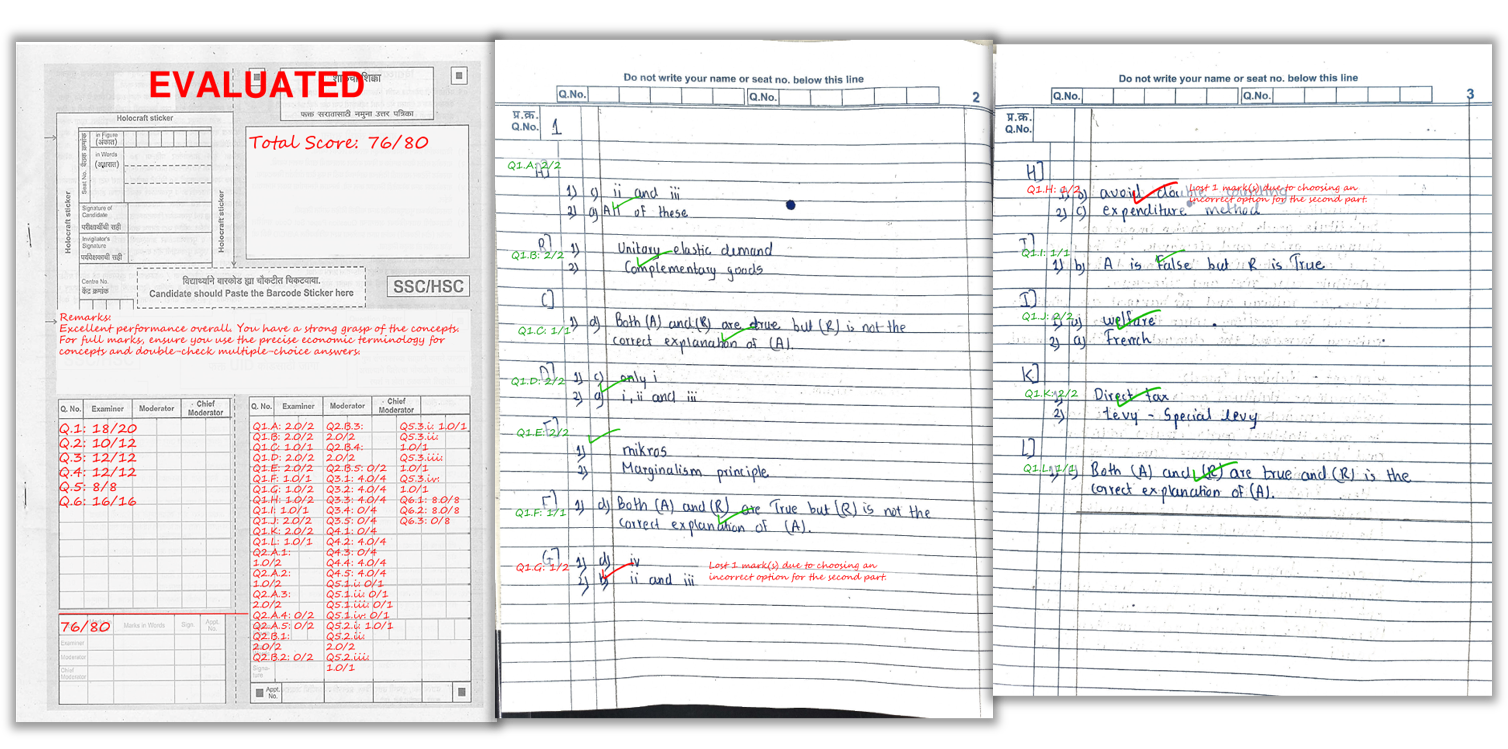
- Marked PDF per student with per-question scores and remarks on the sheet
- Excel summary with total marks and overall feedback for the batch
- Optional batch analytics showing which questions the class struggled with most
A real example of how marks and remarks appear on a student’s answer sheet after AI checking.
Board-Pattern Support
| Board | Supported | Notes |
|---|---|---|
| CBSE | Yes | All subjects, Class 11 and 12 |
| ICSE / ISC | Yes | All subjects including English literature format |
| SSC Maharashtra | Yes | All subjects, HSC pattern |
| All other state boards | Yes | Rubric adapts to any board's marking scheme |
Scanning Tips for Senior Secondary Scripts
- Bright, even lighting: avoid shadows across printed or written text
- Flat pages: reduce page curvature, especially for thick answer booklets
- Full page in frame: all four corners visible, no cropped margins
- Scan sequentially: page order is important for multi-page answer mapping
- Dark ink: faint pencil or very light ink reduces OCR accuracy
Frequently Asked Questions
Can AI award partial marks for Class 12 derivations and numericals?
Yes. When the rubric splits marks across steps — formula, substitution, calculation, final result — AI awards partial credit reliably. A Physics derivation worth 5 marks can award 1 mark per step, so students earn credit for each correct stage.
Does AI checking work for Commerce subjects like Accountancy and Economics?
Yes. Rubric-based evaluation works well for structured formats. For Accountancy the rubric defines correct journal entries, ledger formats, and calculation steps. For Economics it checks concept coverage and example inclusion.
Does the teacher still control the marking scheme?
Yes. Teachers approve the rubric before any paper is evaluated. The AI applies the same rubric consistently to every student without modifying the marking scheme.
What files does the school receive after AI checking?
A marked PDF for each student — with per-question scores and remarks on the sheet — and an Excel summary with total marks and overall feedback for the entire batch.
Is phone scanning good enough for Class 11 and 12 answer sheets?
Yes. With good lighting, flat pages, and the full page in frame, phone scanning is sufficient for accurate AI checking. A flatbed scanner improves throughput for very large batches.
Which boards and subjects are supported?
E-Valuate supports all boards including CBSE, ICSE, SSC Maharashtra, and all state boards. It works for all subjects with written descriptive answers — Physics, Chemistry, Biology, Mathematics steps, Commerce, Economics, History, Geography, and languages.
Ready to automate your answer sheet checking?
E-Valuate AI processes handwritten papers for schools and coaching institutes across India. Sign up free and get 3,000 credits (worth ₹3,000) included.
Start Free — Get 3,000 Credits