
Why This Category Is Growing Fast in India
Schools and coaching institutes across India are moving toward digital evaluation because manual paper checking is slow, inconsistent at scale, and hard to audit. For a coaching institute running weekly JEE or NEET mock tests with 80 to 150 students, manual checking can take 3 to 5 days per test — meaning students are already sitting the next test before they have feedback from the last one.
AI paper checking software solves this by converting scanned handwritten scripts into structured evaluation data, applying a consistent teacher-approved rubric, and returning results within hours. The key is finding software built for Indian classrooms, not just enterprise institutions abroad.
The 6 Features That Actually Matter
1 — OCR/HTR Accuracy for Real Indian Handwriting
The foundation of any AI paper checking tool is its ability to read handwriting correctly. Indian students write in a wide range of styles — fast, compressed, slanted, or mixed script — and the software must handle this reliably.
- Works on cursive, fast writing, different pen pressure, and mixed print-cursive styles
- Handles page skew, uneven lighting, and light ink (within reason)
- Supports multi-page PDFs without skipping or mis-ordering pages
- Degrades gracefully on poor scans rather than producing random marks
How to test this: Upload 10 real answer sheets from your own students and check whether the text extraction is readable before committing to any vendor.
2 — Teacher-Controlled Rubric with Partial Marks
This is the most important differentiator. Any software worth using must let the teacher review and approve the marking rubric before evaluation begins. The AI should apply the teacher's logic — not invent its own.
- Rubric generated from question paper and model answers, then teacher-approved
- Partial marks supported for partially correct answers
- Per-question strictness controls (lenient / moderate / strict)
- Same rubric applied consistently to every student in the batch
3 — Marked PDF Output (Not Just a Score)
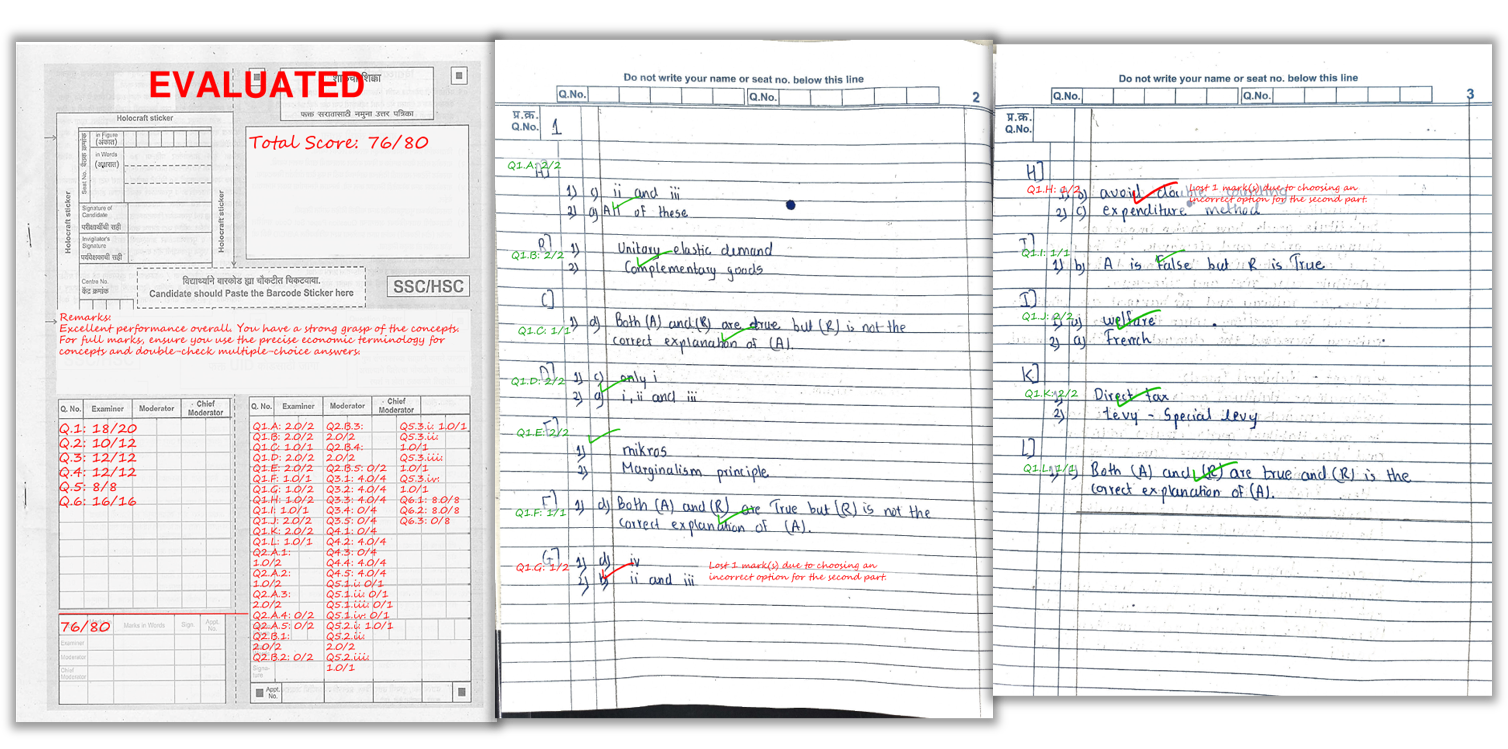
A score number alone is not useful feedback. The best software annotates the student's actual answer sheet with marks and remarks — exactly as a human examiner would. This is what makes the feedback actionable for students.
- Per-question score visible on the sheet
- Short remarks indicating what was missing or incorrect
- Summary section at the end of the marked sheet
4 — Excel Summary and Bulk Download
- Excel/CSV export with total marks and feedback per student
- Bulk ZIP download for all marked PDFs
- Optional question-wise analytics showing class-wide weak areas
5 — No Hardware Requirement
For Indian institutions, this is critical. The software should work with phone scanning — not require a dedicated scanner or any special hardware. Students should be able to submit via a mobile app.
6 — Privacy and Data Security
- Secure storage with access controls per exam or teacher
- Clear data retention and deletion policy
- No selling or sharing of student answer data with third parties
- Compliance with DPDPA (India's Digital Personal Data Protection Act)
Pricing Models to Expect
Most AI paper checking platforms use one of these approaches:
- Per page (pay-as-you-go): simplest for variable-volume schools and institutes
- Credit bundles: pre-purchase credits used as needed — best for coaching institutes with predictable volume
- Monthly/annual subscription: better for large institutions; watch for minimum commitments
- Enterprise custom pricing: USD-denominated global platforms — typically too expensive for Indian SME institutes
E-Valuate AI charges ₹2 per page with credits that never expire. For a 40-student batch with 8-page answer sheets, that is ₹640 per test — accessible for any coaching institute or school.
A real example of how marks and remarks appear on a student’s answer sheet after AI checking.
Shortlist Evaluation Checklist
Before committing to any AI paper checking software, run through this checklist:
- ☐ Ask for a sample marked PDF using your own answer sheets (not a demo sheet)
- ☐ Confirm the rubric is teacher-controlled and editable before evaluation
- ☐ Verify partial marks are supported for your subject format
- ☐ Check data retention and deletion policy in writing
- ☐ Confirm no scanner is required — phone submission must work
- ☐ Check pricing is per-page or credit-based, not enterprise-only
- ☐ Run a 20 to 30 paper pilot before rolling out institute-wide
Frequently Asked Questions
Can AI paper checking software give partial marks?
Yes — when the rubric defines key points and scoring rules, the AI awards partial credit for partially correct answers. This is one of the most important features to verify during a vendor evaluation.
Do schools need a special scanner?
No. Most Indian schools and coaching institutes start with phone scanning. A document scanner helps with very high volume but is not required to get started.
Will it work across subjects?
Yes, as long as rubrics and expected answers are provided. The software works for any subject where answers can be evaluated against a defined marking scheme — Commerce, Science, Humanities, and more.
What outputs will teachers receive?
Teachers receive a marked PDF for each student — with per-question scores and remarks on the sheet — and an Excel summary with total marks and overall feedback for the batch.
How should schools compare AI paper checking vendors?
Ask for a sample marked PDF from your own answer sheets, check that the rubric is teacher-controlled, confirm the data retention policy, verify per-page or credit-based pricing, and run a pilot with 20 to 30 papers first.
What is a fair price for AI paper checking in India?
Per-page pricing in India typically ranges from ₹1.5 to ₹4 per page. E-Valuate charges ₹2 per page with credits that never expire and no minimum commitment.
Ready to automate your answer sheet checking?
E-Valuate AI processes handwritten papers for schools and coaching institutes across India. Sign up free and get 3,000 credits (worth ₹3,000) included.
Start Free — Get 3,000 Credits