
Why Manual Answer Sheet Checking Breaks at Scale
Manual checking is not just slow — it becomes unreliable when volume increases. Teachers in schools and coaching institutes often spend hours correcting stacks of papers after school hours, on weekends, or between lectures. At some point in that process, the marking is not the same as it was at the start.
This is not a failure of effort or professionalism. It is a structural problem: sustained manual checking at volume is genuinely difficult to keep consistent. The fiftieth paper in a session is evaluated with a different level of energy and strictness than the first. Every educator who has corrected a large batch of papers knows this, even if it is rarely discussed openly.
For coaching institutes running frequent test series — JEE, NEET, CA, CS, CMA — the speed problem compounds into a business problem. Students want results quickly so they can review mistakes while the content is still fresh. A three-day turnaround on a weekly mock test means the feedback arrives after the next test is already scheduled.
Common pain points educators report
- Time sink: Hundreds of pages take hours, and re-checks double the workload.
- Inconsistent marking: The "first paper vs hundredth paper" effect happens to every examiner.
- Rubric drift: Even with a marking scheme, strictness shifts across days and evaluators.
- Limited analytics: Most manual checking ends with a total score — not question-wise diagnostics.
- Thin feedback: Teachers rarely have time for detailed, specific remarks on every answer.
What AI Handwritten Answer Sheet Checking Actually Means
AI checking is not a black box. It is a structured pipeline. The system reads the student's handwriting from a scanned image, identifies which answer belongs to which question, compares it against an expected answer and rubric, and assigns marks according to defined rules. In a properly designed system, the teacher stays in control of the rubric and approves all marking logic before any student paper is processed.
The AI does not decide how to mark a paper. It applies the rules the teacher has set. That distinction matters — and it is the reason why AI-assisted checking is trusted by educators when it is implemented with teacher control at the centre.
How AI Answer Sheet Checking Works: The Full Pipeline
Step 1 — Scan and Upload
Students (or staff) scan answer sheets using a phone camera or flatbed scanner. The scan quality directly affects accuracy: clean, flat, well-lit pages produce the best results. On the E-Valuate platform, students use the mobile app to scan and submit their own papers — no physical collection required.
Step 2 — Handwriting Recognition (OCR / HTR)
The system uses Optical Character Recognition (OCR), Handwritten Text Recognition (HTR), and computer vision models to convert the student's handwritten text into machine-readable text. Modern vision-language models can also interpret the layout and structure of an answer — identifying where one answer ends and the next begins, even when students don't follow a strict format.
Step 3 — Question Mapping
The extracted text is mapped to the correct question numbers. This step is critical for question-wise marks and partial credit. Without accurate mapping, marks become unreliable — the system cannot award 3 marks for Q2 and 4 marks for Q3 if it cannot tell which text belongs to which question.
Step 4 — Rubric Application (Teacher-Approved Marking Logic)
The rubric is the heart of the system. It defines, per question: the marks available, the key concepts required, rules for partial credit, and the expected strictness level. In E-Valuate, the AI auto-generates a rubric from the teacher's question paper and model answers. The teacher reviews and approves the rubric before any paper is evaluated. No evaluation runs on a rubric the teacher has not signed off.
Step 5 — Evaluation and Marking
The AI compares each student's extracted answer against the rubric. A well-designed system can:
- Award partial marks when some key concepts are present and others are missing
- Apply the same rubric consistently to every student in the batch
- Generate brief, specific remarks such as "missing definition," "correct method, calculation error," or "example required"
Step 6 — Output: Marked PDF and Excel Summary
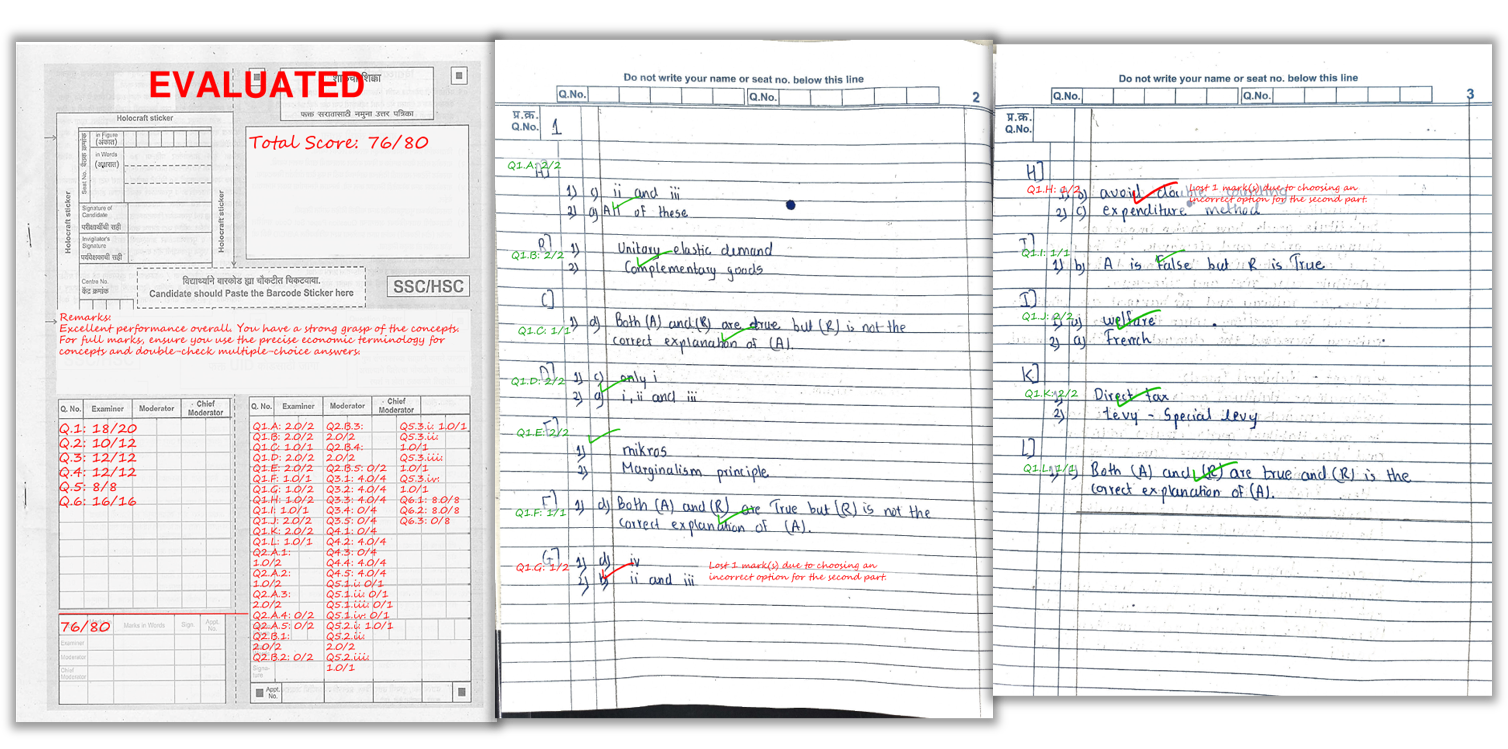
The platform returns two outputs. First, a marked PDF for each student — with per-question scores and remarks written directly on the answer sheet, exactly as a human examiner would annotate it. Second, an Excel summary file for the entire batch — with total marks, overall feedback per student, and question-wise analytics showing which questions the batch struggled with most.
Here is a real example of how marks and remarks appear on a student's answer sheet after AI checking.
Manual vs AI Answer Sheet Checking — Comparison
| Factor | Manual Checking | AI Checking (E-Valuate) |
|---|---|---|
| Speed for 100 papers | 2–4 weeks | 3–6 hours |
| Consistency across batch | Varies — examiner fatigue is real | Same rubric applied to every paper |
| Per-question feedback | Rarely possible at scale | Automated remarks on every answer |
| Batch analytics | Not available without manual tallying | Excel summary + question-wise weak areas |
| Hardware required | None | None — students submit via mobile app |
| Teacher control over marking | Full control | Full control — teacher approves all rubrics |
| Cost per page | Teacher time (high hidden cost) | ₹2 per page, pay-as-you-go |
Why Schools and Coaching Institutes Are Switching to AI Checking
The core reason is not technology — it is time. AI paper checking lets educators shift from repetitive mechanical work (checking) to high-value work (teaching, identifying weak areas, improving instructional plans). For coaching institutes in India, fast and consistent checking is also a competitive advantage: institutes that return detailed results within hours of a test retain students more effectively than those that take a week.
For Class 8–12 schools, the benefit is different: board exam preparation requires frequent practice papers, and teachers simply cannot check 40 papers per student per term without cutting corners somewhere. AI checking makes the volume sustainable.
Subjects and Boards Supported
E-Valuate supports handwritten answer sheet checking for all subjects with written descriptive answers — including Commerce, Economics, History, Geography, Biology, Chemistry, Physics (theory portions), and language papers. It works across CBSE, ICSE, SSC Maharashtra, and all state boards for Class 8 through 12, as well as college-level assessments.
For highly numerical subjects like Mathematics or Physics problems requiring step-wise calculation checking, the rubric needs to be designed carefully to award marks at each step. The platform supports this through partial-mark rules in the rubric definition.
Scanning Tips Checklist — For Best Accuracy
Most "AI accuracy" complaints trace back to scan quality, not the AI itself. Use this checklist before every exam submission:
- Lighting: Bright, even light — avoid shadows falling across the writing.
- Flat pages: Keep pages completely flat — pages that curve near the binding produce distorted text at the edges.
- Full page in frame: All four corners visible in the scan, no cut edges.
- Correct page order: Scan pages sequentially — Pg1, Pg2, Pg3 in order.
- One app, stay open: Students should not exit the app until the upload success message appears.
- Legible handwriting: Encourage students to leave adequate spacing between answers and write clearly.
How E-Valuate AI Fits This Workflow
E-Valuate is built to make rubric-based answer sheet checking practical for individual teachers and coaching institutes — not just large institutions with IT teams. The workflow is:
- Upload your question paper PDF and model answers PDF.
- Review and approve the AI-generated rubric.
- Share the unique exam code with students.
- Students scan and submit via the E-Valuate mobile app.
- Receive marked PDFs and Excel summary — no physical paper handling required.
There is no scanner to buy, no IT setup, and no subscription. You pay ₹2 per page and credits never expire. Sign up and get 3,000 credits (₹3,000 value) free to evaluate your first batch.
Frequently Asked Questions
Can AI give partial marks for subjective handwritten answers?
Yes — when the rubric defines key points and scoring rules, AI can award partial credit if some concepts are correct and others are missing. For example, if a question carries 4 marks and the rubric has 4 key points, the AI awards 2 marks if the student correctly covers 2 of the 4 points.
Will AI answer sheet checking work for messy handwriting?
AI checking works best with legible handwriting and clean scans. Very unclear writing may reduce OCR recognition quality, just as it would for a human examiner. Most accuracy issues come from poor scan quality — bad lighting, blurred pages, or cut corners — not from the AI itself.
Is AI paper checking consistent across all students in a batch?
Yes. Consistent marking is one of the biggest advantages of AI paper checking. The same teacher-approved rubric and strictness level is applied to every student in the batch, eliminating the examiner fatigue and variability that affect manual checking at scale.
What output do teachers receive after AI answer sheet checking?
Teachers receive a marked PDF for each student — with per-question scores, remarks, and a summary written directly on the answer sheet — and an Excel summary file with total marks and feedback for the entire batch. Some workflows also include question-wise analytics showing common weak areas.
How long does AI answer sheet checking take for a full batch?
Smaller batches of 20–30 students typically complete within an hour. Larger batches of 100–200 students can take 3 to 6 hours depending on page count, handwriting clarity, and queue. Still significantly faster than manual checking, which can take days for the same volume.
Is AI paper checking suitable for coaching institutes running test series?
Yes. Coaching institutes running frequent JEE, NEET, CA, CS, or CMA test series are one of the primary use cases. Fast turnaround — results in hours rather than days — allows students to review mistakes while the material is still fresh, which improves learning outcomes and student retention for the institute.
Ready to automate your answer sheet checking?
E-Valuate AI processes handwritten papers for schools and coaching institutes across India. Sign up free and get 3,000 credits (worth ₹3,000) included.
Start Free — Get 3,000 Credits