How AI Understands Handwritten Answers (VLM + OCR + NLP)
Published: · OCR/HTR + VLM + NLP+ rubric-based grading
Why Handwriting is Hard (and Why OCR Alone Isn’t Enough)
Traditional OCR works well for printed text, but handwriting introduces variation in shape, spacing, slant, ink intensity, page curvature, and even scanning shadows. That’s why basic OCR often “breaks” with cursive writing or when answers are written in a hurry.
A modern evaluation system must do more than convert images to letters. It must interpret: where an answer starts, what question it belongs to, and whether the meaning is correct.
OCR vs Intelligent Recognition
Standard OCR is character-level recognition: it tries to identify letters and combine them into words. But students don’t write like textbooks. They cross-out, overwrite, use arrows, draw diagrams, and write half-sentences.
Intelligent recognition combines OCR/HTR with context. If a word is unclear, the model uses surrounding text to predict it—similar to how a human reader guesses a messy word from the sentence.
The Three Pillars of the Technology
- Vision (VLM): Understands the page layout, answer regions, diagrams, and structure.
- Language (NLP): Understands whether the answer’s meaning matches the expected concept.
- Rubric Alignment: Converts understanding into marks using a teacher-approved scheme.
How It Works (OCR → Question Mapping → Rubric → Marking → Output)
Step 1: Scan → image quality normalization
The system first improves input quality: it may deskew pages, increase contrast, and reduce noise. Good scanning reduces recognition errors.
Step 2: OCR/HTR extracts text (and preserves layout context)
OCR/HTR converts handwriting into readable text. Vision models also help interpret layout: margins, headings, question numbers, and where each answer lives on the page.
Step 3: Question mapping (the missing step most tools ignore)
Mapping matters because students may answer out of order or write long answers spanning multiple pages. The platform identifies which parts correspond to which questions so scoring is accurate.
Step 4: NLP checks meaning (not just exact wording)
For subjective answers, exact wording isn’t required. NLP evaluates semantic correctness: whether the student explained the concept, included key points, and avoided incorrect claims.
Step 5: Rubric alignment & partial marking
A teacher-approved rubric defines what earns marks. AI awards partial marks when some key points are present and others are missing, and adds short comments to explain deductions.
Step 6: Output generation
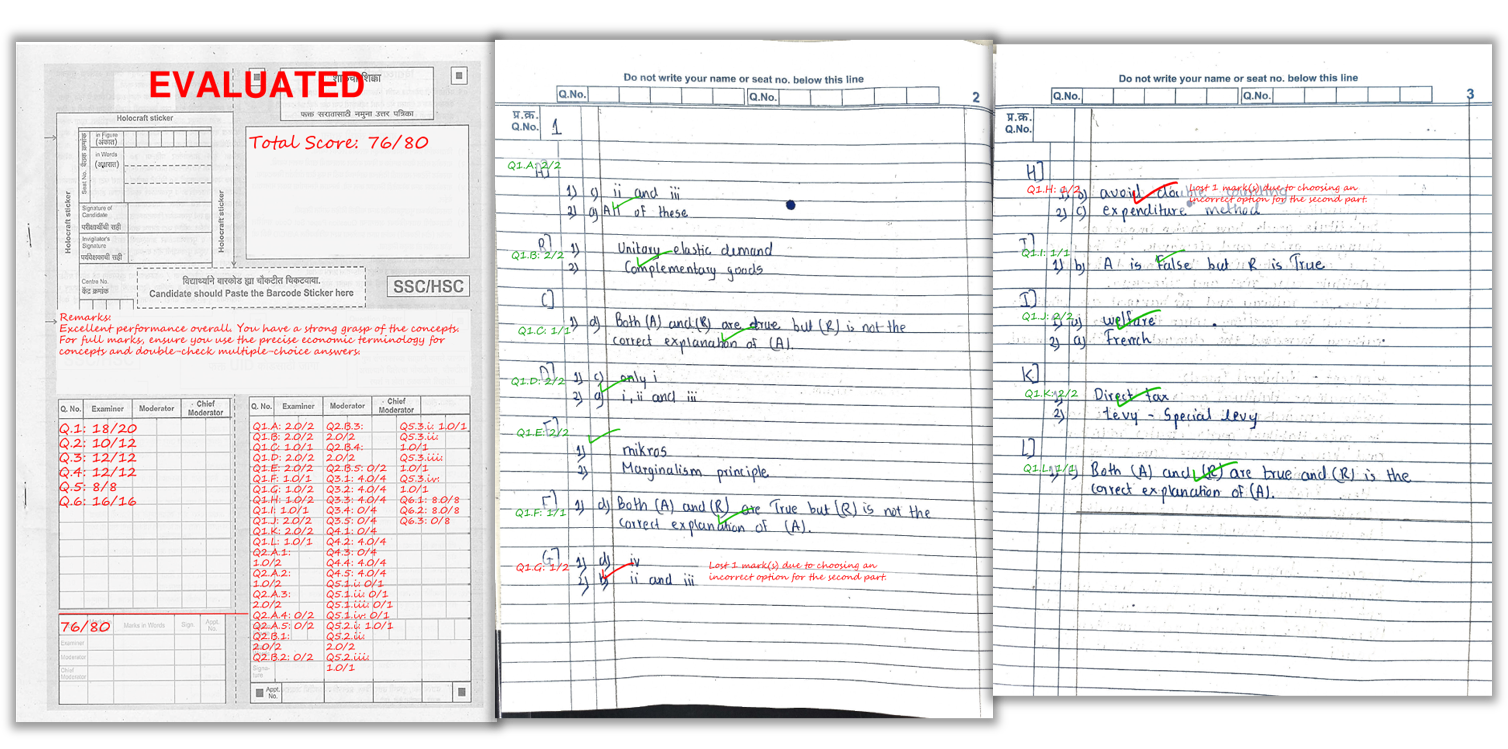
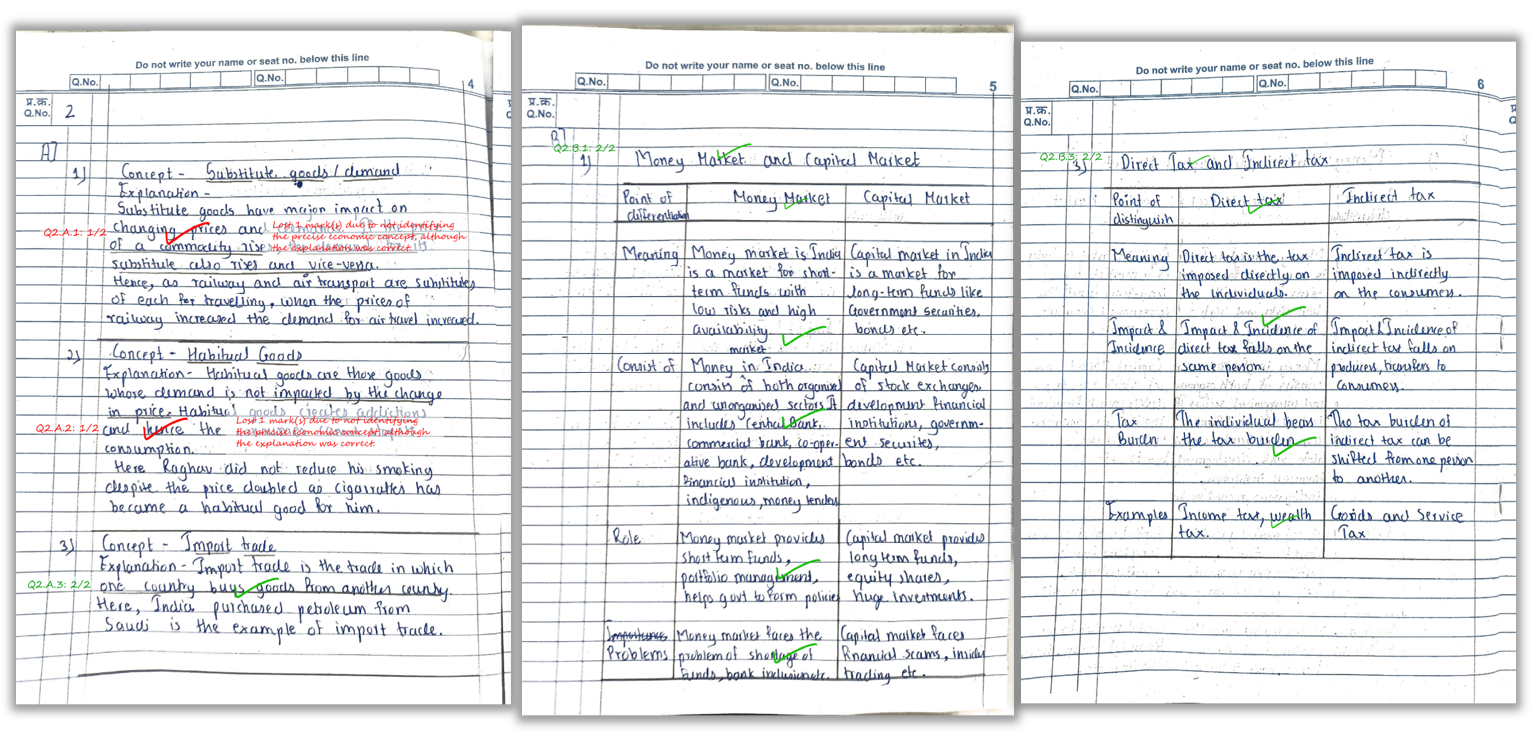
- Marked PDF with per-question marks and remarks on the answer sheet
- Excel summary with totals + overall feedback per student
- Batch insights (optional) about weak questions/topics
Scanning Tips Checklist (to improve OCR/HTR accuracy)
- Use bright light: avoid shadows and glare
- Keep pages flat: minimize curve near binding
- Capture full page: don’t crop margins/corners
- Scan in order: page order helps mapping
- Prefer dark ink: faint pencil reduces OCR quality
See how question-wise marks and remarks appear directly on the student’s answer sheet.
FAQ
1) Is handwriting OCR accurate enough for exams?
For clear handwriting and good scans, yes. Accuracy drops mainly when scans are dark, cropped, skewed, or handwriting is extremely unclear.
2) Does AI require students to use exact wording?
No. NLP focuses on meaning and key points defined in the rubric. Correct ideas in different wording can still earn marks.
3) Can AI detect diagrams and steps?
Vision models can recognize structure and certain diagram/step patterns, but best results come when rubrics specify what must be present.
4) How does AI handle answers written out of order?
Question mapping identifies which text corresponds to each question, even when students answer in a different sequence.
5) What outputs do teachers receive?
Marked PDFs with remarks and per-question scores, plus an Excel summary with total marks and feedback.
Related Reading
Ready to evaluate handwritten answers faster?
Explore Key Features, see Pricing, or Sign Up and start with free credits.